Companies urged to plan for blocked roads, closed ports and absent staff, not just property damage, as anti-immigration protests flare again.
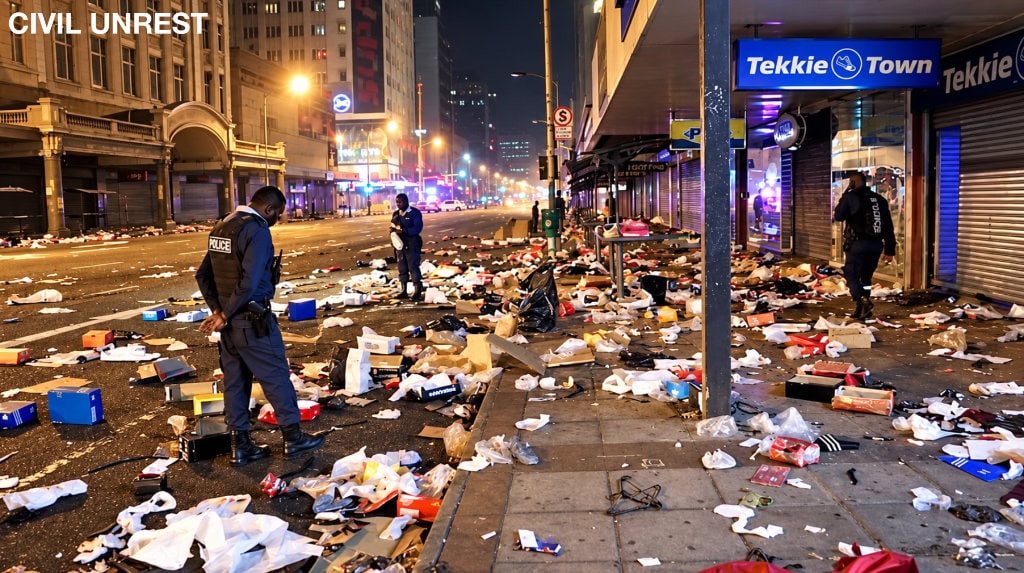
South African businesses that measure civil unrest risk by the value of their buildings are underestimating how exposed they are, says risk consultancy Riskonet Africa. Anti-immigration protests have again led to torched vehicles and looted shops in Soweto and Durban, and the cost of getting it wrong keeps rising.
“The July 2021 unrest taught us that you don’t have to be burnt out to be badly hurt,” says Volker von Widdern, Head: Strategic Risk at Riskonet Africa. “Plenty of companies whose premises weren’t touched still lost weeks of trading. The N3 was closed, cargo couldn’t get in or out of the port, and staff couldn’t get to work. That’s the exposure boards should be looking at.”
Special risk insurer Sasria estimates that the 2021 unrest caused close to R50 billion in economic losses and about R32 billion in insurance claims. Toyota stopped production in Durban, LG’s factory was burnt, and dairy, livestock, sugar, and citrus supply chains were disrupted. Pharmacies were looted, and patients in Gauteng and KwaZulu-Natal struggled to get their medicine. Some businesses never reopened, even after large insurance payouts.
Von Widdern says one of the key causes are economic. “Years of weak growth and extremely high unemployment are the main drivers. Neither has gone away, so we should expect more flashpoints, and they may get worse over time.”
He points to sources of conflict in specific industries where tensions are already showing. These include logistics, where the employment of foreign truck drivers has led to violence, the informal retail sector, where many spaza shops are run by migrants, and illegal mining. “Each of these starts as a local dispute. But any one of them could grow into a regional disturbance if it’s managed badly,” he says.
Migration adds to the pressure. An estimated three million Zimbabweans have moved to South Africa because of political and economic problems at home, and large numbers of Malawians and Nigerians have come too. South Africa’s borders are notoriously porous, with weak physical barriers and poor enforcement at border posts, which has substantially increased the number of undocumented migrants.
The risk doesn’t end with the immediate damage, it impacts investment attractiveness. “When investors see a greater threat to their returns and the safety of their assets, they raise their hurdle rates,” says von Widdern. “Some, like pension funds that need ‘safe’ destinations, may stay away completely. Infrastructure projects can take years to reach financial close, and serious unrest can derail that process.”
Insurance is getting harder to buy, too. Cover exists for unrest damage and for expropriation or the blocking of asset transfers out of a country. “But as unrest risk goes up, insurers’ appetite goes down, and premiums go up,” he says. “Companies need to track the factors that affect whether their regions stay insurable.”
In April 2026 Sasria relaunched R500-million of Wrap Cover above its R500 million primary layer for qualifying clients. Riskonet Africa warns that business interruption cover usually pays only for losses that follow physical damage. Losses caused by blocked roads, supplier failures or a precautionary closure need a careful check of the policy wording.
South Africa’s main exposure is to short, intense disruption. In parts of Africa with long-running conflict, the problem is whether a business can operate at all. Mozambique LNG declared force majeure in 2021 and only fully restarted in January 2026. In Sudan, the WHO reported in April 2026 that 37% of health facilities were not working.
The two can overlap. Mozambique’s post-election protests in 2024 disrupted the Maputo corridor, border posts, and rail traffic, which hit South African exporters as well as local businesses.
“It’s not as simple as saying South Africa is safer or riskier than the rest of the continent,” says von Widdern. “What matters is the specific site, the community, the transport route and what your business depends on. A country rating won’t tell you that. Country risk mainly applies to capital availability and pricing, whereas proactive risk management can unlock returns in new markets.”
Riskonet Africa advises companies to map their critical sites, suppliers, staff transport, utilities, and export routes, and to test what happens when several fail at once. Useful planning scenarios include a three-day local disruption, a two-week corridor shutdown and a three-month loss of a key facility.
Boards should set clear limits on maximum downtime, minimum cash reserves, and reliance on a single route. Staff safety should be part of the continuity plan.
“The businesses that came through 2021 best weren’t necessarily the ones with the most insurance,” says von Widdern. “They were the ones that understood where they were vulnerable before the trouble started.”